Tampilkan postingan dengan label Samsung. Tampilkan semua postingan

Kamis, 02 Juni 2011

T-Mobile releases Samsung Exhibit 4G, Gravity Smart

Samsung_Exhibit_4G Just a day after it announced release dates for the HTC Sensation 4G, T-Mobile is back for more Android fun with the new Exhibit 4G and Gravity Smart. Both smartphones carry a budget price tag and will be out in June.

The Exhibit 4G sports a slim candy bar design in violet or black. The touch screen takes up most of the real estate leaving space below for three touch controls and a physical OK button. You'll use a virtual keyboard with Swype for your typing needs and it all runs on Android 2.3 Gingerbread.

Inside you'll find a 1GHz processor, a 3-megapixel camera with a flash, a front-facing VGA shooter for self-portraits and video chat, Wi-Fi calling, a full HTML browser with Flash, a memory card slot, USB tethering, and support for T-Mobile's HSPA+ network. When you're not being productive, you can watch live and on-demand programming from T-Mobile TV, download movies and TV programs from the Samsung Media Hub, and play preinstalled games like Bejeweled 2, Scrabble and Doodle Jump.

Samsung_Gravity_Smart The Gravity Smart is the first Android handset in Samsung's Gravity series (previous models like the Gravity T ran Samsung's TouchWiz OS). It offers a slider design with a full QWERTY keyboard hidden behind the front face. The keyboard includes a decent selection of shortcut keys (colored in green) and a convenient space bar. The 3.2-inch touch screen also offers a virtual keybaord with Swype.

Features on the Froyo 2.2 device include a full HTML browser, a 3-megapixel camera with a LED flash, a personal organizer, messaging, e-mail, a music player, the usual Google features, and access to apps through the Android Market.

The Exhibit 4G will be $80 after a $50 mail-in rebate and two-year contract. The Gravity Smart will sell for $70 after a $50 mail-in rebate and a two-year contract.

Cnet

Senin, 23 Mei 2011

Samsung previews 22" transparent BLU LCD TV

Samsung has previewed a transparent display, the 22-inch BLU LCD TV, at the ongoing Society for Information Display conference. The television utilizes a transparent panel that is capable of operating without a backlight. The company showed the display in front of several plants, which can be seen through the LCD panel.

blu The transparent displays are expected to be aimed at commercial customers for advertising purposes, however consumer models are said to be on track to launch in the third quarter of the year. The company has yet to announce pricing information or further details.

Electronista

Kamis, 19 Mei 2011

Samsung shows square camera, compact prototypes

Samsung has revealed several prototype cameras, including several square models and three compact designs. The prototypes, which were shown in a picture on the company's Imaging Blog, include a retro-styled design that resembles a Leica X1 or Fujifilm X100. The square camera mimics the appearance of some medium-format mirrorless cameras.

samsungprototypes It is unclear if any of the prototype cameras represent early-stage designs destined for the market, or if they are all simply concept designs. The image was included as part of a closer look into the development and design process that led to the current NX lens lineup.

Electronista

Samsung Gravity T2 leaked, graduates to Android

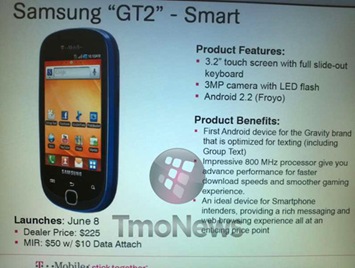
Samsung is planning a sequel to the Gravity T that would upgrade it to the smartphone class. A leak has shown the GT2, likely Gravity T2, using Android 2.2. T-Mobile's phone would use the opportunity to upgrade the hardware underneath, TmoNews learned, including a slightly larger 3.2-inch touchscreen over its slide-out keyboard and an 800MHz processor.

samsunggravityt2The handset would just have a three-megapixel camera with a flash as well as a slightly iPhone-like layout with a large home button and navigation on top. TouchWiz would survive on the device but appears to be lighter than on the Galaxy S series.

Price would be the cornerstone of the phone and stay cheap even with data. Stores would pay a raw cost of just $225, suggesting T-Mobile customers would pay only slightly more off-contract. Contract prices would need a $50 mail-in rebate but only a $10 data plan along with voice.

The Gravity T2 would ship on June 8, the same day as the very high-end HTC Sensation 4G.

Electronista

Senin, 16 Mei 2011

Samsung Infuse 4G, HP Veer 4G hit AT&T shelves

Two smartphones at the opposite ends of the size spectrum reached AT&T stores on Sunday. The Samsung Infuse 4G is the largest smartphone in the US and centers on its 4.5-inch, 480x800 Super AMOLED Plus screen along with a 1.2GHz processor, 21Mbps HSPA+ cellular data, an eight-megapixel rear camera, and a front 1.3-megapixel camera. In spite of the size, the Android 2.2 flagship costs the same $200 on contract as most high-end smartphones.

hpveer-handson The HP Veer 4G meanwhile is one of the smallest phones with just a 2.6-inch, 320x400 screen and a slide-out keyboard. It's the first of the webOS phones designed primarily during the HP era and has a much faster 800MHz Snapdragon processor along with its namesake 14.4Mbps HSPA Internet access and webOS 2.1. AT&T is selling the phone for half as much as the Infuse at $100 on contract.

Electronista

Sabtu, 14 Mei 2011

Samsung shows Retina-like 2560x1600, 10-inch LCD for tablets

Samsung and its frequent partner Nouvoyance said on Thursday they would show an ultra-sharp LCD optimized for tablets. The 10.1-inch, PenTile RGBW-based (red, green, blue, white) screen reaches an unprecedented resolution of 2560x1600. At 300 pixels per inch, the panel's sharpness is double the 1280x800 on most early Android 3 tablets and 2.25 times sharper than the 132PPI of an iPad 2 screen.

pentilergbw PenTile's ability to 'share' color pixels, instead of having separate pixels in stripes, still gives it performance at least as good as a much lower-resolution LCD, the two said. The panel can put out 300cd/m2 of brightness but uses up to 40 percent less power. Outdoors, the panel can kick up to 600cd/m2. Color accuracy is also as good as better mobile screens at 72 percent of the NTSC color range; most tablet screens hit 55 percent.

Samsung anticipated making the screen available to use for shipping products before the end of 2011. Companies still usually have to integrate the hardware and might not have shipping tablets until early 2012. Any tablet shipping with the hardware may need a quad-core processor, quad-core graphics, or both to smoothly drive the extra resolution, though Qualcomm, and graphics core makers like Imagination Technologies are expected to come through at the same time.

The development is most likely to lead to a new version of the Galaxy Tab 10.1 given its manufacturer, but Samsung's willingness to manufacture displays on contract could lead to at least other Android tablet makers signing onboard. Apple uses Samsung for iPad 2 displays but would have to get Samsung to cut the display down to 2048x1536 if it were to double its existing pixel density.

Regardless of manufacturer, the LCD should be the first to offer an effect similar to Apple's Retina Display at tablet sizes, creating a "pixel-free" image better for 1080p video, photos, and text.

Electronista

Selasa, 10 Mei 2011

Samsung Droid Charge (Verizon Wireless)

samsung-droid Verizon customers now have two 4G Android smartphones to choose from: the HTC Thunderbolt ($249.99, 4 stars), our current Editors' Choice, and the $299.99 Samsung Droid Charge, which is Samsung's first LTE device, and first officially designated Droid device for Verizon. The two cell phones are pretty similar, but not identical. While the HTC Thunderbolt retains a slight edge, you'll be thrilled with either device.

Design, Screen, and Call Quality
The Samsung Droid Charge measures 5.1 by 2.6 by 0.5 inches (HWD) and weighs 5 ounces. That makes it almost an ounce and a half lighter than the HTC Thunderbolt, but even slightly taller. The Droid Charge isn't as impressive looking, though, mainly thanks to its all-plastic design (save for the glass screen). The chrome trim around the edge and the glossy, tapered cover on back feel a bit cheap and seem to scratch easily.

The 4.3-inch, 480-by-800-pixel, Super AMOLED Plus capacitive touch screen is just as vibrant as other recent Samsung phones. The deep blacks and vibrant colors look great, and overshadow even the Thunderbolt's excellent screen. There are four plastic buttons beneath the screen. I like these better than the Samsung Galaxy S's finicky touch buttons, but HTC's haptic feedback-enabled design beats them both. Typing on the on-screen QWERTY keyboard was easy in both portrait and landscape modes, and dialing phone numbers was very fast.

The Droid Charge is a dual-band EV-DO Rev A (850/1900 MHz) and 4G LTE device with 802.11b /g/n Wi-Fi. With the LTE radio, Verizon says to expect download speeds in the 5 to 12 Mbps range, and upload speeds between 2 and 5 Mbps. We've gotten even higher speeds in some tests, though. You can also use the Droid Charge as a mobile hotspot with the appropriate plan; it can support up to 10 devices when running 4G, or five devices when in 3G mode. Interestingly, Verizon is promising to throw in the mobile hotspot feature for a limited time, instead of charging an extra $20 per month; that's a great deal, assuming you want that feature (and you do).

Voice quality was very good: crisp, clear, and loud in the earpiece. Callers had no trouble understanding me, either, although one caller said that I sounded a little thin through the microphone. Reception was solid. Callers sounded clear through an Aliph Jawbone Icon Bluetooth headset ($99, 4 stars). The speakerphone went loud enough to use outside, but it sounded over-compressed and muffled. Voice dialing took several tries over Bluetooth to get the right number. I'm not sure why this is, but it could have something to do with the way the Droid Charge activates and deactivates its power-saving algorithm, as some of the Jawbone Icon's voice prompts were partially cut off.

We got some strange battery life results in our tests. The Droid Charge has a larger battery than the HTC Thunderbolt, 1600mAh compared to the Thunderbolt's 1400mAh. We saw very good standby and regular-usage time on the Charge - after a full day of sitting around, its battery life didn't drop much. But we repeatedly got short talk time results of between 4 hours, 15 minutes and 4 hours, 28 minutes, which is much shorter than we got on the Thunderbolt. Seeing those, we can't recommend this phone to people dissatisfied with the Thunderbolt's battery life; we'd expect the two phones to have similar experiences.

Hardware, OS, and Apps
Under the hood, the Droid Charge has the same 1GHz Cortex A8-based Hummingbird CPU found in half a dozen Galaxy S handsets over the past year. By now, it would have been nice to see an upgrade. The Droid Charge runs Android 2.2 (Froyo); there's no word yet on an Android 2.3 (Gingerbread) update. On our benchmark test suite, this phone tested slightly slower overall than the Thunderbolt, which packs a second-generation 1GHz Snapdragon CPU.

Samsung treads a bit more lightly than HTC with its UI layer. Most of the apps are stock, albeit with minor color or graphic enhancements. This is good and bad; I missed HTC's excellent address book layout, which looks livelier and makes it easier to access a contact's history than Samsung's does. The Droid Charge continues Samsung's tradition of wrapping menu icons in colored blocks. The seven customizable home screens work well.

PCmag

Minggu, 08 Mei 2011

US Cellular to launch LTE-based 4G in 2011

samsungmesmerizeUS Cellular on Friday leapt on 4G with its own plans for an LTE network. The carrier planned to have at least 25 percent of its network covered by the end of 2011 and would focus on cities that haven't been priorities for Verizon. Some of the first cities would include Madison, Milwaukee, and Racine in Wisconsin; Cedar Rapids, Davenport, and Des Moines in Iowa; Greenville in North Carolina; and both Bangor and Portland in Maine.

Multiple 4G devices would be paired up with the launch, though what these would be wasn't given out. LTE would continue to expand through the course of 2012.

The addition of LTE would make US Cellular one of the earlier adopters of the much faster cellular Internet access in the US. Verizon already has an established network and hopes to be largely done by sometime in 2013. AT&T is due for its first commercial service before the end of 2011. Sprint hasn't given more than minor hints of a 4G switch so far, and T-Mobile is now mostly depending on a buyout by AT&T to get a fast track.

Moving to LTE will eventually let customers on AT&T switch to US Cellular without necessarily having to switch devices, and those on Verizon and other US LTE networks switch without the difficult and sometimes impossible device reactivation process on CDMA. It could eventually allow a

Electronista

Sabtu, 07 Mei 2011

Samsung Replenish Review: A Smarter Green Phone

Samsung-Replenish Environmentally friendly, "green" phones started popping up about two years ago, with the debut of the Samsung Blue Earth and Sony Ericsson GreenHeart feature phones in the summer of 2009. Initially I thought the idea was a bit of a gimmick. But here we are in 2011, and the green phone has made a comeback in the form of the Samsung Replenish ($50 with a two-year Sprint contract as of May 5, 2011). Running Android 2.2, the Replenish is one of the first ecofriendly smartphones. Unfortunately, allthough you might feel like a better person for buying an ecofriendly phone, the Replenish is largely underwhelming.

Earth-Friendly Design

Keeping true to its identity as a green phone, the Replenish is constructed with "reduced environmentally sensitive materials," according to Sprint. That is, its materials are free of polyvinyl chloride and phthalates, beryllium, and brominated flame retardants. If that means nothing to you, don't worry--you're not alone.

Basically, the Replenish meets the European Union's Restriction of the Use of Certain Hazardous Substances (RoHS) Directive, which limits the use of certain chemicals and materials in electronics. Furthermore, the Replenish's casing includes 34.6 percent postconsumer recycled plastic content; according to Sprint and Samsung, 82 percent of the phone is made from recyclable materials.

Okay, that's great and everything, but how does the Replenish look? Well, I can't say that it is the prettiest phone. The face is piano black with chrome detailing, while the backing has a slight texture to it. It isn't ugly, by any means, but it does look a bit plasticky. We received a black review unit, but the phone also comes in a slightly more attractive "Arctic Blue" as well as "Raspberry Pink" (which isn't coming until June).

The face of the 4.84 by-2.36-by-0.45-inch phone is split between a 2.4-inch display and a full QWERTY keyboard. Four hardware buttons separate the keyboard from the display (the standard Menu, Home, Back and Search keys). The 2.4-inch QVGA display is decent for using basic apps, reading e-mail and texts, and looking at certain Websites, but the low resolution and smallish size make it less than ideal for watching video.

The full-QWERTY keyboard isn't the best I've ever used, but it is decent enough for hammering out messages and short e-mail messages. It is a little on the narrow side, and the keys could be better contoured (ala BlackBerry keyboards) for more comfortable typing. I fear that people with larger hands might have a harder time using this keyboard.

Eco Features

The Replenish runs standard, unadulterated Android 2.2 (better known as Froyo), so it has no custom interface overlay. We've written a lot about Froyo in the past; for starters, check out our hands-on look at Android 2.2.

Last October, Sprint introduced Sprint ID--packages of mobile apps, wallpapers, and themes designed for specific groups such as sports fans, fitness buffs, or auto enthusiasts. Naturally, the Replenish comes loaded with the Sprint ID Green Pack. The home screen is loaded with the latest in all things green, from TreeHugger.com (one of my favorites), Earth911, and GreenBiz.com. You also get access to TreeHugger TV videos as well as Earth911's iRecycle app, which makes finding recycling drop-off sites easy.

Flip to the right, and you'll see the 'Live Green' screen, which has a widget that gives tips from Green America and a link to the Green You app, a carbon-footprint calculator. Flip to the left of the home screen, and you'll see the 'Shop Green' screen, which offers a widget from GreenDeals.org, sort of an eco version of Groupon. You'll also find a link to EcoEtsy.com and eBay Green.

One neat option is the Replenish's solar-charging battery cover, which lets you charge your phone on the go. The cover is sold separately, but Sprint has not announced pricing for it. (We didn't get one in for testing, which is unfortunate since we're having rare sunny weather in San Francisco this week!) Solar chargers and cases take quite a bit of time to give a phone battery more juice, but selling such a backing is a clever idea. I do wish it came included with the phone, however.

Mediocre Camera

The Replenish's charger meets the European Commission Code of Conduct on Energy Efficiency of External Power Supplies--which, again, doesn't really mean much to the average consumer. One useful feature, however, is that it will give you a visual alert when it is fully charged.

The Replenish's 2-megapixel camera is nothing to write home about. It has no flash, so photos taken in poorly lit environments look fuzzy and dark. Photos that I took indoors--even with sufficient lighting--had a bit of a dark cast to them. My outdoor photos had nice colors, but details were a bit blurry.

The Replenish also offers video capture, but my videos looked about as fuzzy as my photos did.

Spotty Performance

The Replenish froze and crashed quite a few times during my hands-on review. While I was navigating through the App Drawer, the phone first froze and then entered hands-free activation for driving--even though I didn't select that option. When I tried to add a new Sprint ID pack, the Replenish required me to do a force shutdown. Finally, I had to restart the Replenish for the Sprint ID pack to work.

Call quality was decent over Sprint's network in San Francisco. Even though I was making my calls on busy city streets, my colleagues couldn't hear anything in the background with the exception of a large truck going by. My contacts reported that I came through loud and clear, and that my voice sounded fairly natural. Oddly, I couldn't really say the same for my friends' voices; they sounded as if they were talking too close to the speaker--even though they swore they weren't.

Bottom Line

Nobody loves the environment more than I do--seriously. I applaud Sprint for its sustainability efforts. From contributing money to the Nature Conservancy to initiating an aggressive cell phone recycling program, more tech companies should follow in Sprint's footsteps. That said, I'm still not sold on a "green" phone. It is a neat idea, but manufacturers need to figure out a way to make a phone both green and desirable. The Replenish's low-resolution display, mediocre camera, and buggy performance just don't do the trick.

On the plus side, Sprint is offering some nice incentives. Priced at $50, the phone is incredibly inexpensive, and you can sign up for Sprint's Everything Data plan for unlimited text, Web, and calling for just $70 per month. Furthermore, Sprint is waiving the $10 monthly premium data add-on charge for going green. The Replenish is a good deal with good intentions--if you can get past the underwhelming performance and occasional crashing.

PCWorld

Samsung Exhibit 4G for T-Mobile leaks with 1.4GHz chip

samsungexhibit4g A leak Friday night confirmed that T-Mobile is lining up a more direct replacement for the Samsung Vibrant. The Exhibit 4G would be a close relative of the Galaxy S Plus and use its 1.4GHz processor, five-megapixel camera, and Android 2.3, but with some conspicuous upgrades and downgrades. TmoNews saw that it would have a slightly smaller 3.7-inch (though still 480x800) screen, but it would pack a front VGA resolution camera and its namesake HSPA+ data, though whether it would be 14.4Mbps or 21Mbps couldn't be identified.

The control scheme would be its most unusual aspect; rather than have the four touch buttons of the Vibrant or most US Galaxy S phones, it would use a consciously iPhone-like home button and reserve the rest for up top. Performance would be strictly middling at somewhere between the Galaxy S and the Motorola Droid X.

No release details exist for the Exhibit 4G. However, its appearance in working form with a final name could have it coming soon. The earliest opportunity is a known Samsung event on May 24.

Electronista

Jumat, 06 Mei 2011

ASUS confirms Eee Pad Transformer shortage, cites demand

asuseeepadtransformer ASUS partly confirmed rumors of Eee Pad Transformer shortages on Friday through a statement from spokesman David Chang. He didn't acknowledge talk of just 10,000 of the Android 3.0 tablets shipping in April but anticipated that it would take at least a month to get back on track, with 100,000 in May and 200,000 in June. There would be a "significant alleviation" of shortages by June, Chang told NetbookNews, two months after it went on sale.

The representative wouldn't touch on beliefs that the shortage had been caused by Apple's supply demands for the iPad 2 cutting into ASUS' supply. He instead argued that demand for the Transformer was exceeding predictions "by far." While the tablet is available worldwide, US distributors have cast doubt on claims of sheer interest since retailers didn't receive promised stock to gauge supply.

The 300,000-plus sales would still give ASUS a rare win in the mobile space over some of its competitors. While still just a small fraction of what Apple sells, the number would eclipse the 250,000 Xooms Motorola shipped in the winter. Depending on Motorola's performance in the spring, the Eee Pad Transformer could be the most popular Android 3.0 tablet. Samsung's Galaxy Tab 8.9 and 10.1 may be popular but aren't shipping until early June.

The Transformer has earned much of its reputation through offering relatively high quality but for just $400 in a 16GB edition, $200 less than the 32GB-only Xoom and $100 less than a 16GB iPad 2. Its signature trick is an optional keyboard dock that also supplies a trackpad and a second battery that boosts it to 16 hours of use.

Electronista

Samsung Infuse 4G official, drops May 15 for $200

samsunginfuse4g AT&T and Samsung at their New York City event tonight formally priced and dated the Infuse 4G. The largest-ever dedicated smartphone should reach the carrier's shops on May 15 and should still cost the same $200 on contract as other smartphones. AT&T is preloading a special copy of Angry Birds with a special, contest-enabling unlockable stage as well as a 2GB microSD card loaded with movie trailers.

Early adopters also get a bonus $25 coupon for video downloads from Samsung's Media Hub. Stores should have several case choices as well as car and desk mounts.

The flagship is centered on its 4.5-inch Super AMOLED Plus screen, which while 480x800 is seen as ideal for movie viewing. Performance also appears to sit between the Galaxy S and the Galaxy S II with a 1.2GHz but possibly single-core processor, although it's the first AT&T phone to support a full 21Mbps HSPA+ Internet link that earns the name. Along with affording room for both an eight-megapixel back camera and a front 1.3-megapixel camera, the sheer size allows for a relatively thin design at about 0.36 inches deep at its thickest point.

Android 2.2 ships out of the box, but it's not clear if or when the phone will move to 2.3 or later.

Electronista

AT&T, Samsung Launch Infuse 4G Smartphone

samsung-infuse-4g AT&T and Samsung on Thursday announced the sale date and price for the Infuse 4G, the carrier's first smartphone with the HSPA+ 21 speeds that we consider to be the minimum for true 4G. The phone will go on sale on May 15 for $199 with a two-year contract.

First previewed at CES in January, the Infuse is an interesting phone: it's unusually thin, long and wide. The Android 2.2 phone is of the standard black-slab style, but it has a 4.5-inch, 800-by-480 screen. That isn't higher resolution than the usual smartphone screen, but it's wider. The screen also sports Samsung's Super AMOLED Plus technology, which combines the increased outdoor visibility of Super AMOLED with more subpixels for truer colors. The phone is also very slim, at 9mm.

The Infuse has AT&T's fastest Internet speeds yet, but it's not quite the fastest smartphone AT&T has to offer; with a single-core, 1.2-Ghz Samsung processor, it's a bit slower than the dual-core Motorola Atrix. It's still faster than most of the other smartphones on the market, though.

Other specs include an 8-megapixel camera, Bluetooth and Wi-Fi. The phone comes with a 2GB memory card that can be upgraded to 32GB.

Earlier today, AT&T senior vice president of devices Jeff Bradley told me that the carrier considered any phone with speeds of HSPA 14.4 or higher to be 4G, when combined with the right network. Other folks, such as myself, Chris Ziegler of thisismynext.com, and (at one point) T-Mobile chief network officer Neville Ray, consider HSPA+ 21 to be the minimum speed to deliver an experience significantly faster than 3G phones. The Infuse also supports HSUPA, a key technology which allows for fast upload speeds.

AT&T and Samsung are trying to attract buyers with a unique gimmick: a pre-loaded version of Angry Birds with an exclusive, Infuse-only level that, when solved, makes players eligible for prizes. Don't laugh! People love Angry Birds.

The first 500,000 phones sold will come with a $25 credit towards Samsung's Media Hub movie store. The phone also streams video from AT&T's U-Verse TV, along with other Android-powered media apps.

At $199, the Infuse costs $100 more than the HTC Inspire 4G, another big-screen Android phone, but the Infuse has both a faster processor and faster Internet than the Inspire. The Motorola Atrix also costs $199 and offers a faster processor, but it also can't match the Infuse's modem speeds.

We'll have a review of the Samsung Infuse 4G soon.

PCmag

Kamis, 05 Mei 2011

Samsung Galaxy Tab Wi-Fi caught using slower hardware

The Wi-Fi-only version of the 7-inch Samsung Galaxy Tab uses lower-spec components than the 3G version, beyond just the radio. As confirmed the official page, the Wi-Fi tablet uses a 1GHz A8 Cortex CPU paired with an older PowerVR SGX530 graphics core. The 3G version of the tablet has a 1GHz Cortex A8 as well, but it's a newer generation C110 version, the Hummingbird, along with a newer SGX540 for video.

The resulting slow performance of the Wi-Fi tablet is well documented by users on the XDA Developers forum. They and others have lashed out at Samsung for giving users the low speed, particularly given the late timing. Galaxy Tabs with 3G were reaching stores as early as September 2010, but the Wi-Fi version isn't reaching customers until well after Apple and others had eclipsed both Samsung tablets in performance.

Other features have also shown some degradation, as the Wi-Fi tablet gets Bluetooth 2.1 rather than Bluetooth 3.0, again according to the product page.

Electronista

Could the ASUS Eee Pad Transformer be the killer Android tablet?

ASUSEeePadTransformertablet The ASUS Eee Pad Transformer tablet looks very impressive on paper - and on the shelf, with its low price tag - and could be set to embarrass larger rivals if it outsells the Samsung Galaxy Tab 10.1 or Motorola Xoom.

Taiwanese manufacturer ASUS came to prominence as a disruptive force in low-end laptops - well, netbooks - and is now taking its low prices to Android-powered tablets. But this time, ASUS is not going for low power: the Eee Pad has a full 10.1-inch screen, Tegra 2 power, and the very latest, optimized-for-tablets version of Android, dubbed 'Honeycomb'.

Indeed, the ASUS Eee Pad Transformer has almost identical specs (and dimensions) to the Motorola Xoom, but sells for exactly half the price (US$399); it can even humiliate Moto's flagship Atrix 4G smartphone with its so-called Lapdock� when the Eee Pad is hooked up with its optional laptop dock, making it a first-ever Honeycomb lappie that's more powerful than the Atrix + Lapdock combo. To disrupt things further, ASUS' keyboard accessory is a full two hundred dollars cheaper than Motorola's, yet is actually more useful and versatile.

The only cheaper tablet would be one running Android 2.2 - which is not intended for tablet usage - and with far inferior specs, such as the critically panned Huawei IDEOS S7, replete with its appalling resistive screen and crappy stylus.

So, with Motorola and Samsung unwilling to state how many of their tablets they're actually selling - preferring instead to stress how many they have shipped, which might obscure how many are sitting unsold in warehouses - ASUS now has a killer opportunity to become a surprise second to Apple in the iPad/tablet wars/ How do you fancy ASUS' chances, or the Eee Pad hardware itself?

CNET

Slimmed Galaxy Tab 10.1 Wi-Fi reaches FCC

samsunggalaxytab101-ctia Samsung has delivered a new version of ts Galaxy 10.1 tablet to the FCC for certification. Identified as the GT-P7510, the device has also received interoperability certification from the WiFi Alliance. Samsung is still just rolling out its original 10.1 tablet.

The new Galaxy 10.1 is 2.3 mm tablet thinner than its predecessor (8.6mm vs 10.9mm). By comparison, the iPad 2 is 8.8mm thick. Samsung has announced that the Wi-Fi-only version of the Galaxy Tab 10.1 will arrive in US stores on June 8, priced at $500 for the 16GB version and $600 for the 32GB model. A 16GB iPad 2 with Wi-Fi nearly matches that price at $499, and the 32GB iPad 2 costs $599.

Electronista

Selasa, 03 Mei 2011

Samsung Stride SCH-R330 (U.S. Cellular)

SCH-r330Red 002 The Samsung Stride is a no-frills flip phone. We like no-frills flip phones. Many offer great ways to save money on your monthly bills, especially when used in conjunction with a separate music player. If it's on a budget-priced regional carrier like U.S. Cellular and you live in the appropriate coverage area, so much the better. But the Stride is too lazy; it feels like a three-year-old cell phone that's still on sale, instead of something new. There are better choices at the U.S. Cellular retail counter.

Design and Call Quality


The Samsung Stride measures 3.7 by 1.9 by 0.7 inches (HWD) and weighs 3.1 ounces. It's made entirely of plastic, though Samsung adds a little flair with its textured, translucent front cover and metal-look red accents. The 1.1-inch, passive-matrix external display offers a retro-looking, 8-bit style LED clock. I like it, but your mileage may vary. The internal 1.9-inch LCD offers 176-by-220-pixel resolution, and looks sharp and bright for a low-end phone. The numeric keypad features large, soft-touch keys that are extremely comfortable to use, despite their somewhat flat look. Five function keys surrounded a hard plastic, rounded, five-way control pad. Dialing numbers and navigating the device were a cinch.

The Stride is a dual-band 1xRTT (850/1900 MHz) device with no Wi-Fi. Voice calls sounded good overall, with a clear, balanced tone in the earpiece, plenty of gain, and no background hiss. Callers had few complaints as well, and reception was good. Calls sounded clear through an Aliph Jawbone Icon Bluetooth headset ($99, 4 stars). The Nuance-powered voice dialing worked perfectly over Bluetooth without training. The speakerphone sounded clear and went loud enough for outdoor use; always a good thing. Battery life was fine at five hours of talk time.

Apps, Multimedia, and Conclusions


Samsung designed what it calls Touchwiz Lite, a stripped-down version of the company's proprietary UI layer, for the Stride. The main menu features twelve small icons arranged in a grid pattern. You get the usual compliment of basic phone tools, like a stopwatch, voice recorder, and a 500-entry phone book. The Novarra Web browser requires several key presses and sluggish page loads before letting you enter a URL. It's fine for displaying WAP pages once you put up with that nonsense. The mobile e-mail client connects to all the major Web portals, but it's sluggish, and this isn't a texting phone anyway.

The Stride's Bluetooth situation is confusing. Samsung and U.S. Cellular stamp "stereo Bluetooth" all over the Stride's marketing materials, but the Stride has no music player, GPS, or other app that could possibly take advantage of this. The 1.3-megapixel camera has no flash or auto-focus. Test photos looked soft and grainy both indoors and out, even in bright sunlight; they'll do in a pinch, but don't buy this phone for its camera. There is 49MB of free internal storage, but no memory card slot; you can only share photos via picture message or Bluetooth.

U.S. Cellular has a pretty diverse lineup these days, though few devices are as inexpensive as the Stride. The LG Wine II UN430 ($39.99, 3.5 stars) remains our Editors' Choice for its sleek styling, larger LCD displays, faster EV-DO data, built-in music player, memory card slot, and excellent voice quality; it's easily worth the extra $30 up front. The Samsung Messager Touch SCH-R630 ($29.99, 3 stars) and the Motorola Grasp (Free, 3.5 stars) are two good choices for heavy texters, with full QWERTY keyboards and (in the case of the Messager Touch) a 2.6-inch touch screen, although neither is as quite as well rounded as the LG Wine II in other respects. Finally, if you can swing a few more bucks per month, the LG Optimus U ($29.99, 4 stars) is a killer budget Android smartphone that lets you run thousands of third-party apps, as well as browse the Web on a higher-resolution, 3.2-inch capacitive touch screen.

Benchmarks


Continuous talk time: 5 hours 0 minutes

PCmag

Samsung Galaxy S 4G Review

Samsung Galaxy S 4G Report

samsung-galaxy-s-4g The Samsung Galaxy S 4G picks up where the Vibrant left off, adding 4G HSPA+ speeds of up to 21Mbps, a front-facing VGA camera, enhanced battery life, and Android 2.2 with Flash 10.1 support. The rest of the phone is strikingly similar to its 3G predecessor, even down to the disappointing lack of a camera flash. T-Mobile also dangles the carrot in front of its customers by preloading the movie Inception onto the phone in order to show off the Galaxy S 4G's Super AMOLED screen. This is a classic T-Mobile incentive, and one that should make Christopher Nolan happy. James Cameron got his jollies with Avatar preloaded on the Vibrant. According to numbers, the Samsung Galaxy S 4G is T-Mobile's fastest phone to date when it comes to network speeds, as long as you live within range of the company's advanced towers. For the rest, the Samsung Galaxy S 4G is just another Galaxy S phone. Let's take an in-depth look at the Samsung Galaxy S 4G.

Design

The Samsung Galaxy S 4G did not fall very far from the Vibrant's mold when it came to architecture. In fact, the fa�ades of both phones are nearly identical, sporting 4-inch 800 x 480-pixel Super AMOLED screens and standard Menu, Home, Back, and Search haptic feedback touch controls. However, the Galaxy S 4G adds a front-facing VGA camera for video chat via QIK. Just like the Vibrant, the Samsung Galaxy S 4G is thin and easily pocketable. When it came to screen resolution, our experience was identical to the Vibrant's�Inception looked fantastic on the super bright screen, and we had no trouble viewing in direct sunlight.

The only noticeable difference is the Samsung Galaxy S 4G's back panel, which features an iridescent gunmetal paint job that shifts when rotated in the light. We liked the swanky looks of the Galaxy S 4G over the Vibrant's odd bubble pattern design�the Galaxy S 4G just stands out. Unfortunately, the Samsung failed to incorporate an LED flash in the back of the Galaxy S 4G, and that costs them some major points, as you'll find out in the Camera section.

External controls remain simplified, with a roster that consists of an undersized Volume control, 3.5mm audio jack, Power/Lock button, and USB terminal with sleek sliding cover. Underneath the phone's back panel lurks the preloaded 16GB MicroSD card in a slot that houses up to 32GB, SIM card, and larger 1650 mAh battery compared to the Vibrant's 1500 mAh juice box. The Samsung Galaxy S 4G displays some noteworthy design improvements, but it's not enough to significantly distance the phone from the Vibrant.

Software and Interface

The Samsung Galaxy S 4G emulated the Vibrant when it came to our overall interface experience. The phone is governed by a 1GHz Hummingbird processor and features a TouchWiz interface in conjunction with Android 2.2 OS. Although the Vibrant didn't ship with Android 2.2, it received an upgrade to keep up with the times. So, in terms of hardware speed, both phones were very similar, minimizing the learning curve to a flat line. The smartphone offers Stereo Bluetooth, GPS, WiFi, and calling over WiFi for a guaranteed signal. Flash 10.1 support is also part of the package, and the Samsung Galaxy S 4G allowed us to watch our embedded YouTube review videos right from within the browser with a lag-free performance.

It's not that the interface on the Samsung Galaxy S 4G is underwhelming�it's still a great system. However, not much has changed since the Vibrant, which places Samsung in a definitive safe zone. Either that, or it means the clock was ticking and Samsung had to crank out a 4G phone in order to stay on top of the competition (TouchWIZ 4 will for instance be powering the Galaxy S2). We still found solace in the little eccentricities on the Galaxy S 4G's interface that attracted us to the Vibrant in the first place. For instance, in order to call a contact, all we have to do is swipe to the right across their name and left to text message them. We could also assign individual sounds for emails, texts, and other notifications, which were levels of customization not offered by many other devices.

For the social networker, the phone offers Buddies Now, which compiles a list of your favorite Facebook, MySpace, and Twitter pals and tosses them into a virtual Rolodex with synched status updates. There's also the all-encompassing Feeds and Updates widget that acts as a contact-wide bulletin board, and the Samsung Galaxy S 4G supports numerous photo sharing accounts like Flickr, Photobucket, Kodak, and Snapfish. Video chat users can jump on QIK, which is also preloaded, and the phone has Microsoft Exchange ActiveSync for email. Of course, the Android Market, Gmail, Maps, and other Google services are part of the package, and let's not forget about Inception being preloaded as well.

Although the Samsung Galaxy S 4G appears to be a well-equipped speed demon, we did experience some minor lagging, quite similarly to the Samsung Vibrant. For instance, while using TeleNav GPS, the application simply froze and disabled the rest of the phone until we powered off and back on. There is a handy Program Monitor that allowed us to monitor RAM memory and kill active applications, and that came in handy for smoother OS operation and battery conservation. The phone also has doubleTwist, which synchs iTunes music, playlists, videos, and pictures via AirSync. We're impressed with the versatility of the Galaxy S 4G, but it's not that far removed from the Vibrant.

Call Quality/Battery Life

Like the Samsung Vibrant, we had nothing to complain about with the Samsung Galaxy S 4G when it came to call quality. Despite the hubbub of traffic and town noises, we were able to have unmolested calls, thanks to the phone's polished microphone system. Although Samsung upgraded the Galaxy S 4G's battery to a 1650 mAh pack, we only discovered a minute boost in phone stamina. Naturally, we tested games, took pictures and video, browsed the Internet, and made calls, but by the end of the day, the phone was hurting for some electrical juice. Our advice is to keep an eye on the phone's Program Monitor and make sure the brightness of the phone is not set to maximum.

Camera

We actually had a better experience with the 5-megapixel camera on the Samsung Galaxy S 4G than we did with the Samsung Vibrant. We're not sure if Samsung changed the glass or tweaked the sensor a bit but all of our bright light testing ranked among the better phones we've seen in this class. At times, the phone had a tendency to oversharpen, but for the most part, colors were natural and detail was uninhibited.

Unfortunately, Samsung chose to omit a flash for the second time on the Galaxy S 4G, so we had to shoot in Night mode any time the lighting was not favorable. Night mode worked surprisingly well, however, but we found that it was difficult to capture blur-free images because of the shutter speed sacrifice. The bottom line is that the Samsung Galaxy S 4G needed a flash, and it didn't get one.

The same applied to video mode. 720p bright light performance was good, although it didn't live up to the same standard as the phone's still image quality, thanks to its unpredictable frame rates and occasional lack of detail. Still, we were able to attain some decent footage up until the lights dimmed. Without a Night mode or Flash to shoot with, video mode at night was essentially useless.

On the plus side, the Galaxy S 4G has a stellar camera interface, just like the Samsung Vibrant. We have numerous Scene modes, Shot Modes, manual controls, and a new Default Destination option, which lets us choose where we wanted the images to ultimately end up. The Front Facing Camera also came in handy for self-portraits, and for most users, the camera will be fine in bright light. But we're still bitter about that lack of flash!

Infosync

Samsung takes 200K Galaxy S II pre-orders, passes iPhone 4

samsunggalaxysii-launch Samsung claimed an at least initial win for the Galaxy S II. The company took over 200,000 pre-orders across all three major Korean carriers between Monday of last week and the launch on Friday. About 160,000 of those were at the country's largest carrier, SK Telecom.

The pre-orders cracked 10,000 units in the first 29 minutes and doubled that in just over an hour, at 64 minutes.

Samsung's results blew past iPhone 4 pre-orders last August and set a relatively high but potentially surmountable barrier for Apple. The American firm took just over half as many pre-orders last year, but it also had just KT as its only carrier and only added SK Telecom as a carrier in March. Apple has yet to launch any iPhone on more than one Korean carrier at the same time.

Samsung's long-term, worldwide ambitions for the Galaxy S II are relatively modest. It plans to sell 10 million of the phones in all of 2011, or the same as it sold of the original last year. A wider range of Android phones should still lead to larger results, but its caution suggests it doesn't necessarily expect to beat other Android makers. Apple already shipped 18.65 million iPhones just in the winter.

Electronista

Senin, 02 Mei 2011

Samsung Sliding PC 7 up for pre-order at Amazon

SamsungSlidingPC7 Samsung's Sliding PC 7 hybrid is now up for pre-order at Amazon. No shipping dates are yet available, either from Samsung or Amazon, though the price is set at $650. The device's 10-inch, 720p touchscreen display slides open to reveal a hardware QWERTY keyboard.

Processing power comes from a 1.5GHz Intel Atom Z670 along with 2GB of RAM onboard and a 32GB solid state drive. Front 1.3- and rear 3.0-megapixel cameras are present, as is Wi-Fi but no 3G. The device ships with Windows 7 Home Premium and weighs a relatively light 2.2lbs.

The hybrid was originally expected to cost $700 and arrive in March.

Electronista